



Name
Capella University
NURS-FPX4025 Research and Evidence-Based Decision Making
Prof. Name
Date
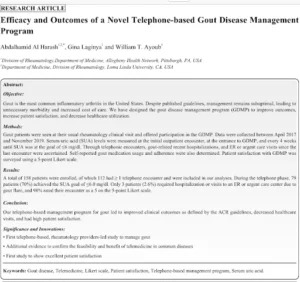
Figure 1
Keywords: Gout disease, Telemedicine, Likert scale, Patient satisfaction, Telephone-based management program, Serum uric acid
Reference
Al Harash, A., Laginya, G., & Ayoub, W. T. (2021). Efficacy and outcomes of a novel telephone-based gout disease management program. The Open Rheumatology Journal, 15(1), 51–56.
Date of Publication: 11 August 2021
DOI: https://doi.org/10.2174/1874312902115010051
The research conducted by Al Harash, Laginya, and Ayoub (2021) evaluates the effectiveness of a structured telephone-based disease management program designed for individuals diagnosed with gout. The article explores whether remote follow-up through telecommunication can improve patient outcomes, treatment adherence, and satisfaction while reducing complications associated with uncontrolled serum uric acid levels. Gout is a chronic inflammatory condition characterized by elevated uric acid in the bloodstream, leading to painful joint inflammation and recurrent flare-ups. Managing this disease effectively requires continuous monitoring and adherence to urate-lowering therapies.
The study aims to determine whether consistent telephone monitoring, medication adjustment, and patient education can help patients achieve recommended uric acid targets and improve overall disease control.
| Criterion | Details |
|---|---|
| Type of Study | The article describes a prospective quality improvement (QI) initiative that evaluated the outcomes of a structured telephone-based gout management program implemented in a rheumatology practice. |
| Evidence Pyramid Level | The study corresponds to Level V evidence, which includes quality improvement projects, case studies, and program evaluations. Although useful for clinical insight, this level provides weaker evidence compared with randomized controlled trials or systematic reviews. |
| Methodology | A total of 158 patients diagnosed with gout were recruited between 2017 and 2019. Participants received routine rheumatology care along with scheduled telephone follow-ups. During these calls, healthcare providers monitored serum uric acid levels every four weeks, evaluated medication adherence, adjusted treatment plans when necessary, and assessed patient satisfaction using a Likert scale questionnaire. |
| Credibility Factors | The research was carried out by experienced rheumatology clinicians and involved a moderately large patient population. Data included both clinical indicators (serum uric acid levels) and patient-reported outcomes, which strengthens reliability. However, the absence of a control group limits the ability to compare results with traditional in-person management. |
| Relevance to Diagnosis | Achieving a serum uric acid level of ≤6 mg/dL is a central diagnostic and therapeutic target for gout management. The study demonstrates that consistent telephone follow-up can assist patients in reaching this goal, which decreases disease flare-ups and long-term joint damage. |
| Workplace Application | Healthcare organizations can incorporate telephone-based monitoring to improve chronic disease management. This approach allows providers to evaluate laboratory results, adjust medications promptly, and remind patients about treatment adherence. Such programs may reduce hospital admissions and emergency visits related to gout complications while lowering healthcare costs. |
Figure 2
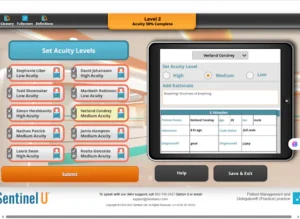
Patient Name: Verland Condrey
Diagnosis: Acute gout flare accompanied by inflammation of the left lower extremity
Treatment: Intravenous fluids, intravenous colchicine therapy, and patient-controlled analgesia (PCA) for pain management
Care Plan: Continuous monitoring for respiratory complications, management of severe pain rated at 8/10, supportive nursing care, and evaluation of the patient’s response to medications and fluid therapy.
The study conducted by Al Harash et al. (2021) investigated whether a structured telephone follow-up system could enhance clinical outcomes for individuals living with gout. The program was created to support patients in maintaining serum uric acid (sUA) levels at 6 mg/dL or lower, which is widely recommended by clinical guidelines for gout management. Maintaining this target level helps prevent crystal deposition in joints, reduces the frequency of painful attacks, and limits long-term complications such as joint deformity.
Between 2017 and 2019, 158 patients diagnosed with gout were enrolled in the program. Among them, 112 individuals participated in at least one structured telephone consultation. During these calls, healthcare professionals reviewed laboratory results, evaluated patient symptoms, and modified medication regimens when necessary.
Patients were instructed to measure serum uric acid levels every four weeks. These regular assessments allowed providers to monitor progress toward the treatment target and ensure that medications were effective. Additionally, the telephone consultations served as opportunities to reinforce education about lifestyle modifications, medication adherence, and symptom monitoring.
The findings indicated that the program produced positive clinical outcomes. Approximately 70% of participating patients successfully reached the recommended uric acid target by the end of the monitoring period. Achieving this biochemical goal is associated with improved disease control and a reduced likelihood of gout flare-ups.
Furthermore, the study reported improvements in medication adherence. Patients were more likely to continue taking urate-lowering therapies when they received consistent follow-up and encouragement from healthcare providers. The program also contributed to a reduction in emergency department visits and hospitalizations related to severe gout attacks.
Patient feedback was overwhelmingly positive. Most participants reported high levels of satisfaction with the telephone-based follow-up system. The remote format provided several practical advantages, including reduced travel requirements, lower healthcare expenses, and easier access to healthcare professionals.
These benefits demonstrate that telemedicine interventions can significantly enhance patient engagement and participation in long-term disease management.
The evidence presented by Al Harash et al. (2021) is particularly valuable because effective gout management relies on consistent monitoring of serum uric acid levels and adherence to prescribed medication. The study demonstrates that structured telephone follow-ups can help patients maintain appropriate uric acid levels, which is essential for preventing recurrent flare-ups and long-term joint damage.
Regular communication with healthcare providers also improves patient awareness of disease management strategies. By reinforcing treatment plans and monitoring laboratory values, telemedicine programs can strengthen patient engagement and encourage proactive management of chronic conditions.
Several factors contribute to the credibility of the research. First, the article was published in a peer-reviewed rheumatology journal, ensuring that the methodology and findings underwent scholarly evaluation. Second, the study included more than one hundred participants and utilized structured data collection methods. Additionally, the research evaluated both objective clinical indicators and subjective patient satisfaction measures.
However, a notable limitation of the study is the absence of a comparison group receiving only standard in-person care. Without such a comparison, it is difficult to determine the exact magnitude of the telephone program’s impact relative to traditional treatment models.
Despite its limitations, the research provides practical insights for healthcare providers, particularly nurses and chronic disease management teams. Telephone-based monitoring programs can serve as an effective supplement to traditional clinic visits by providing ongoing support between appointments.
Healthcare organizations may adopt similar programs to improve treatment adherence, ensure timely medication adjustments, and detect complications earlier. In addition to improving clinical outcomes, telemedicine initiatives can increase patient satisfaction and reduce healthcare expenditures associated with emergency care or hospitalization.
Article Link
https://doi.org/10.2174/1874312902115010051
Al Harash, A., Laginya, G., & Ayoub, W. T. (2021). Efficacy and outcomes of a novel telephone-based gout disease management program. The Open Rheumatology Journal, 15(1), 51–56. https://doi.org/10.2174/1874312902115010051